There’s a particular kind of tired that senior leaders don’t talk about much at work. Not the tired that comes from too much work, which we all know how to describe. The other one: making consequential calls faster than you can properly think them through, month after month, with fewer people around you to test the thinking against. If that’s familiar, keep reading.
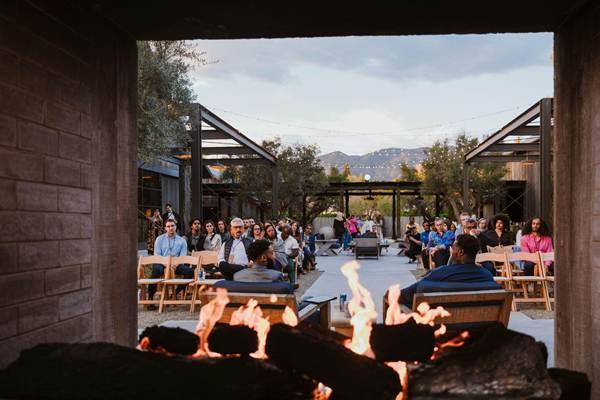
From September 30 to October 2, about fifty senior leaders will spend three days at the Ojai Valley Inn doing something most of us have quietly stopped making room for, which is thinking out loud in front of people who have no stake in the outcome. It’s called the Yardstick Innovation Institute, and my firm, DSG Global, hosts it. I spent two years on the Coqual side of this work, so I know what three days off your calendar is worth, and I wouldn’t ask for them lightly.
It is not a conference. It’s an executive retreat, deliberately small, built for honest conversation rather than broadcast. This is the ninth edition since 2022, and its reputation comes almost entirely from what it refuses to be: there is no main stage with a keynote you could have watched later, and no panel performing expertise at itself. The leaders come from worlds that rarely overlap, from sport, tech, healthcare, consumer brands, and investment, people who would never normally share a table, all working the same underlying questions about leadership, culture, and change from completely different angles. Task Force members spend most of the year in rooms full of people who do roughly what they do, and that has real value; it’s also why you already know most of what the person across the table is going to say. This room is built the other way around.
This year’s theme is The Future Is Human: Elevating the Game of Human and Tech-Driven Performance. The programming is built around AI and performance, but the questions underneath it are the ones that land on your desk: what work people should be doing now, who gets developed for it, and how you keep good judgment in the room when the tools move faster than the people using them. Over the three days that plays out across human optimization and the science of peak performance, strategic leadership under pressure, AI and neurotechnology, the new frontier of inclusion and well-being, and courageous leadership in a digitally accelerated era. You are being asked right now to make calls about workforce design, AI adoption, and who gets invested in, often with fewer colleagues internally to pressure-test the decision. Those are precisely the questions this room is organized around.
The people in it this year include Leigh Steinberg, the original “Jerry Maguire”; DeRetta Rhodes, Chief People and Culture Officer of the Atlanta Braves; Mike Pilliod, the materials innovator behind breakthrough glass technology at Apple and Tesla; X. Eyeé, CEO of Malo Santo and formerly an AI leader at Google and Microsoft; former Olympians Leslie Maxie and Louise Hazel; actor, director, and record-holding freediver Tanc Sade; and Super Bowl champion Brendon Ayanbadejo. Take the pairing of Rhodes and Eyeé: a people leader running culture for a professional sports franchise, and someone who built AI at two of the largest technology companies in the world, working the same problem from opposite ends of it. That conversation isn’t happening anywhere else on your calendar. Past attendees and partners have included Google, DoorDash, Indeed, Nike, Salesforce, Apple, Boeing, Netflix, Amazon, Patagonia, Meta, and CNN.
The format is designed so people can put down the performance of having it all figured out. Attendees talk plainly about what’s hard, and they get answers from outside their own industry’s assumptions. You often learn more from the leader two industries over than from anyone holding a microphone, and the relationships tend to outlast the three days by years. The setting does some of that work too: the Ojai Valley Inn is about ninety minutes north of Los Angeles, and stepping away from the usual room, the usual screen, and the usual city is part of how the conversation opens up in the first place.
A few things you should know before deciding. Registration is $2,995 before the discount, and travel and accommodation are on top of that. It costs you three days and a flight. There is no breakout track to duck into if a session isn’t landing, and nothing gets recorded for you to watch later. The room is small enough that not participating is obvious to everyone in it. If what you need this quarter is a specific skill or a certification, there are better uses of the time and money. If what you need is a few days to think clearly, with people who will tell you the truth, this is unusually good at that.
If you want to come, Task Force members can register with the code COQUAL for 25% off, and the code extends to colleagues. Registration covers all programming, meals, and curated activities; travel and accommodation are separate, and there’s a discounted guest rate at the Ojai Valley Inn. If your organization would rather help build the room than sit in it, a small number of sponsorship conversations are still open, and an email to [email protected] will reach me.